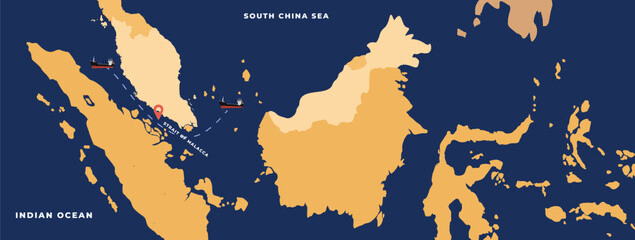
With the Hormuz Strait shut down, a substantial part of the world’s oil is being stifled. This is putting a burden on Europe and China. If the Strait of Malacca (pictured above) were to suffer any obstructions or delays, China, which depends highly on imported energy, would be seriously impaired in its industrial capacity. It’s cost of transporting oil would double, and the time for delivery would double as well! China already has a 20 year inventory of real estate, and if its industrial capacity were to be truncated, as a nation, it would collapse for certain. Communism would be dead in the water! The following is an interesting analysis of the Epic Fury agenda which may not be fully explained by our leadership, and therefore not fully understood by peoples of the world including Americans.
We are back in an era of hard resource power and Mahanian sea power. Geography matters again. Chokepoints matter again. Energy, food, minerals, and shipping routes matter again. And above all of it still sits American monetary power, reinforcing advantages that the United States and the wider Western Hemisphere possess in abundance.
So, what is the real meaning of Operation Epic Fury? Epic Fury is not about Iran, except in the most superficial sense. Iran is the trigger, not the subject. The subject is power: who has it, who depends on it, and who discovers in a crisis that he owns less of it than he imagined.
The operation exists to stop Iran’s nuclear march, yes. But strategically its significance is broader. It is a reminder that deterrence still works when it is credible, and that credible force still reorganizes the thinking of rivals who have spent too long mistaking American restraint for American decline. Epic Fury is not occupation. It is not nation-building. It is peace through strength in action.
And the moment the Hormuz shock hit, the larger lesson came into view.
China is exposed. Europe is exposed. Britain is exposed. That is not moral commentary. It is a structural fact. China’s industrial scale does not make it resilient. It makes it hungry. Beijing remains dependent on energy flows that move through narrow maritime chokepoints, above all Hormuz and Malacca. The famous “Malacca dilemma” is not a seminar-room abstraction. It is the strategic vulnerability at the center of the Chinese growth model. China can manufacture on a grand scale. It still cannot fuel itself without running a maritime gauntlet it does not control.
Europe and Britain face the same truth in softer language but no less harshly in practice. They regulated and outsourced their way into dependency. They constrained domestic supply, moralized about energy production, and assumed that open sea lanes and reliable imports were a permanent feature of modern life. They are not.
Hormuz was a reminder that access is not control, and interdependence is not security. That is the first point. Size is not resilience. Dependency dressed up as globalization is still dependency. The second point is that the old energy order is cracking. The UAE’s exit from OPEC signals more than a tactical disagreement. It suggests that cartel discipline is giving way to national advantage under pressure. In a harder world, producers will not subordinate their interests to old club arrangements. They will maximize leverage.
Trump deserves credit here. “Energy dominance” was mocked by the usual classes as crude rhetoric. In reality it was strategic common sense. Expanding hydrocarbons, building LNG capacity, and treating domestic production as national power rather than moral embarrassment put the United States in a stronger position for precisely this kind of world.
But the larger lesson matters more than any one policy slogan. Epic Fury clarified, rather than changed, the structural map. The Western Hemisphere is resource-secure. Europe and Asia are not. The United States, Canada, and the Americas possess hydrocarbons, LNG capacity, farmland, freshwater, critical minerals, and strategic depth on a scale the import-dependent powers of Europe and Asia cannot match. This is not a matter of clever management. It is a matter of geology, geography, and political inheritance. Everyone else is trying to secure inputs from afar. The Americas hold them at home.
This crisis did not weaken that position. It clarified it. And that takes us to the point that too many analysts still insist on treating as a separate subject: Hard resource power and monetary power are mutually reinforcing.
“King Dollar” is not a superstition. It is the monetary expression of hard power. Energy is priced in dollars, commodities are traded in dollars, and global balance sheets are saturated with dollar liabilities. That is why every supposed age of “de-dollarization” evaporates the moment a real shock arrives. When energy flows are threatened and trade routes seize up, the world does not run from the dollar. It runs toward it. Then comes the swap line. Federal Reserve swap lines are not mere technical plumbing. They are instruments of hierarchy. In a dollar shortage, the Fed can extend emergency liquidity to allied central banks and withhold it from others, effectively deciding who gets access to the world’s most important funding source in a crisis. That is not neutral market management. It is power, exercised quietly but unmistakably.
This is Epic Fury’s real significance. It shows both layers of American strength at once. The United States can still shape physical risk in the world’s key energy corridors, and it still sits at the center of the financial architecture that prices and distributes those resources. Hard resource power below, monetary power above.
Pax Americana, understood as a frictionless global system that America guaranteed indefinitely and at discount prices, is over. What comes next will be harsher, more selective, and more explicit. The Great Game has changed, but it has not disappeared. It has returned in more material form. Hard resource power and monetary power reinforce one another, and the United States sits at the center of both. That’s Epic Fury’s real significance.
For China, that means the Malacca dilemma remains unresolved. For Europe and Britain, it means dependency remains dependency, no matter how elegantly it is described. For the United States and the wider Americas, it means something simpler: The commanding heights of power are still occupied by those who control resources, routes, and money.
Epic Fury is not really about Iran. It is a reminder of that fact.
Dr. James Thorne is chief market strategist at Wellington-Altus Private Wealth and holds a Ph.D. in economics. Follow him on X at @DrJStrategy.
There is no need to be afraid, but better to be modest in good luck and our ancestors’ hard work.
The above article was supplied by Dr. Paul Cameron below:
Paul Cameron, Ph.D.
Chairman, Family Research Institute
POB 62640 Colorado Springs, CO 80962
303 681 3113

 aceloewgold
 georgeclilly
 pensiamentopeligroso
