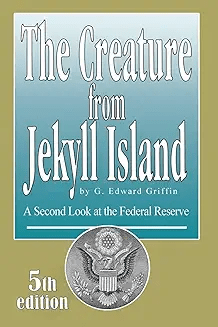
The Creature from Jekyll Island
“The following article was generated by Grok 4 (xAI) in response to prompts from [Jack
Kettler]; I have edited it with Grammarly AI for style.”
Review of G. Edward Griffin, “The Creature from Jekyll Island: A Second Look at the Federal Reserve” (American Media, 1994; 5th ed., 2010).
In “The Creature from Jekyll Island,” G. Edward Griffin offers a meticulously researched, intellectually provocative examination of the Federal Reserve System’s origins, operations, and broader implications for monetary sovereignty, political economy, and individual liberty. Framed as a “second look” at an institution long shrouded in opacity, Griffin’s work transcends conventional financial historiography to present a compelling ontological critique of centralized banking power. Drawing on primary sources, including participants’ memoirs, congressional records, and contemporary financial analyses, Griffin constructs a narrative that is accessible to the informed lay reader and rigorously grounded in historical evidence, making it an indispensable contribution to heterodox political economy and critical studies of monetary governance.
The book’s central thesis is both bold and methodologically precise: the Federal Reserve is not a neutral public institution but a privately orchestrated banking cartel, conceived in secrecy on Jekyll Island, Georgia, in November 1910 by a cabal of elite financiers representing Morgan, Rockefeller, and international banking interests (including Paul Warburg of Kuhn, Loeb & Company). Griffin meticulously reconstructs this clandestine meeting—attended by figures such as Senator Nelson Aldrich, Assistant Treasury Secretary A. Piatt Andrew, Frank Vanderlip, Henry Davison, Charles Norton, and Benjamin Strong, as the genesis of a cartel agreement with five explicit objectives: eliminate competition from emerging regional banks, secure a monopoly franchise to create money ex nihilo for lending, centralize control over national bank reserves, socialize inevitable losses onto taxpayers through government guarantees, and cloak the entire enterprise in the rhetoric of public protection and economic stabilization.
Griffin argues that this cartel was neither accidental nor benign; it was a deliberate fusion of financial and political elites, mirroring earlier European central-banking models while subverting the constitutional principles of sound money enshrined in the U.S. founding documents. The narrative unfolds in six thematically organized sections. Part I (“What Creature Is This?”) sets the historical context of the Jekyll Island conclave and explains the mechanics of bailouts. Subsequent sections offer a “crash course” on money, elucidating the “barbaric metal” of gold-backed currency versus fiat systems, and introduce Griffin’s now-iconic “Mandrake Mechanism,” a lucid explanation of how government debt is monetized through fractional-reserve banking, generating inflation as an insidious, regressive tax that transfers wealth from producers to the financial class. Later chapters trace the Fed’s role in engineering boom-and-bust cycles, facilitating wars (including the financing of both sides via the “Rothschild Formula”), precipitating the Great Depression, and advancing a supranational architecture of debt-based globalism through institutions such as the IMF, the World Bank, and precursors to the United Nations. Griffin concludes with a forward-looking analysis of “doomsday mechanisms” and seven compelling reasons for abolishing the Federal Reserve, advocating a return to commodity-backed money as the bulwark of liberty.
Griffin’s methodological strengths are particularly noteworthy. Far from a speculative conspiracy, the analysis rests on an impressive evidentiary foundation: direct quotations from Vanderlip’s memoirs, Warburg’s own writings, Aldrich’s correspondence, and period journalistic accounts (e.g., Harold Kellock’s 1915 profile in “The Century Magazine”). The author’s interdisciplinary approach, integrating monetary theory, institutional history, political philosophy, and even literary analogy (the Frankensteinian “creature” of the title), illuminates the epistemic opacity of modern finance. By demystifying concepts such as endogenous money creation and the political economy of debt, Griffin equips readers to discern structural incentives that mainstream economics often obscures behind technocratic neutrality. His prose, while erudite, maintains narrative momentum akin to a detective story, rendering complex mechanisms (e.g., the conversion of Treasury bonds into circulating currency) transparent without sacrificing analytical depth.
Scholarly contributions abound. Griffin’s work aligns with and extends heterodox traditions, including the Austrian critique of fractional-reserve banking as inherently destabilizing and public-choice analyses of regulatory capture. It anticipates contemporary debates on monetary sovereignty, endogenous money, and the “economic deep state,” offering a prescient framework for understanding phenomena such as quantitative easing, taxpayer-funded bailouts, and the inflationary erosion of purchasing power observed in subsequent decades. By situating the Fed within a longer arc of cartelization and globalist aspirations, Griffin challenges the teleological narrative of central banking as an inevitable response to market failures, instead portraying it as a contingent, and reversible, political artifact. Its enduring relevance is evident in post-2008 financial crises, persistent debates over inflation, and renewed calls for monetary reform, affirming the book’s status as a foundational text in critical political economy.
In sum, “The Creature from Jekyll Island” stands as a landmark achievement in exposing the architecture of financial power. Griffin does not merely chronicle events; he unveils the incentive structures and ideological underpinnings that have made fiat central banking a potent instrument of wealth transfer and political centralization. For scholars of economic history, monetary policy, and institutional critique, this volume offers both diagnostic clarity and normative urgency. Its call for the restoration of sound, decentralized money resonates as a defense of human flourishing against the encroachments of cartelized finance. As monetary debates intensify in an era of unprecedented public debt and digital currency experimentation, Griffin’s analysis remains not only timely but essential, a clarion work of truth-seeking scholarship that merits wide engagement across disciplines. Highly recommended for its rigor, insight, and transformative potential.
“The above article was generated by Grok 4 (xAI) in response to prompts from [Jack Kettler]; I have edited it with Grammarly AI for style, and using AI for the glory of God.”
“For the weapons of our warfare are not carnal but mighty in God for pulling down strongholds, casting down arguments and every high thing that exalts itself against the knowledge of God, bringing every thought into captivity to the obedience of Christ.” (2 Corinthians 10:4-5)
God Bless,
Jack Kettler
Go to the conservative web hub at:
http://www.undergroundnotes.com/
Thanks to my friend Jack!
Pensiamento Peligroso

 Break The Matrix
 Children's Health Defense
 Dan Bongino – The Dan Bongino Show
 Dr. Dave Janda
 Dr. David Martin
 For The Love of Freedom
 G. Edward Griffin – Need To Know News
 Greg Hunter USA Watchdog
 Jack Kettler – Underground Notes
 James Corbett – The Corbett Report
 John Stossel – Fox Business
 Luke Rudowski – We Are Change
 McAlavany Commentary
 Mercola
 Mike Adams – Natural News
 Mike Rivero – What Really Happened
 Paul Cameron – Family Research Institute
 Paul Craig Roberts – Institute for Political Economy
 Paul Joseph Watson
 Peter Schiff – Schiff Radio
 Ron Paul – Campaign for Liberty
 Stefan Molyneux – Freedom Radio
 The New American Magazine
 Thomas Sowell
 VisualPolitik EN
 aceloewgold
 pensiamentopeligroso
 Touch Stone Connect