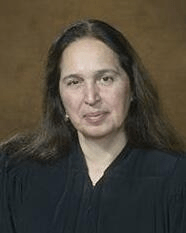
No more tyrannical judges stabbing Americans in the back HERE! Hopefully this is the end of judicial tyranny! You won’t believe this illegal immigrant violence with impunity HERE!
Check Out This Judge’s “LEFTIST” Credentials!
Can One District Judge Overrule The President Of The United States And The Will Of The People?
Expanded review offered by Epoch Times:
The Supreme Court issued a landmark opinion on June 27 that effectively restrained judges’ ability to issue sweeping orders blocking the president’s policies. Known as nationwide injunctions, the number of orders has exploded in frequency, with a particular spike under President Donald Trump.
In a 6–3 decision, the Supreme Court said that Congress hadn’t granted judges authority to issue broad relief to individuals not before the court. Some of the details still need to be ironed out and the ultimate fate of Trump’s policies has yet to be decided. However, the court’s order did give the administration leverage in fighting federal judges on how far they can limit the president’s policies.
At a more practical level, the decision temporarily halted three nationwide blocks on Trump’s attempt to limit birthright citizenship.
The judges who issued those orders are expected to reconsider them in light of the Supreme Court’s latest decision. Ultimately, their orders could wind up back at the Supreme Court, as could a deeper debate about the constitutionality of Trump’s policy on birthright citizenship.
Here are some of the key takeaways for the decision and how it could impact future policies.
Nationwide Injunctions Not Consistent With Nation’s History
The majority’s primary holding focused on the Judiciary Act of 1789 and whether it allowed judges to issue nationwide injunctions.
It refrained, however, from deciding whether Article III of the Constitution, which generally outlines federal courts’ authority, allowed judges to issue such orders. Article III has been cited by Republicans and was used by the Trump administration to argue against the injunctions on birthright citizenship.
Regardless, Justice Amy Coney Barrett’s majority opinion indicates that nationwide injunctions don’t align with how courts have operated in both the United States and England. “
The universal injunction was conspicuously nonexistent for most of our Nation’s history,” Barrett said. “Its absence from 18th- and 19th-century equity practice settles the question of judicial authority.”
Broad Relief Still Possible
A key aspect of Barrett’s opinion indicated that broad relief was not necessarily bad but depended on who the plaintiffs in particular cases were. Courts, she said, could issue orders designed to provide “complete” relief for the parties before the court rather than other individuals in similar situations.
One of the blocks on Trump’s policy came from a case known as CASA, Inc. v. Trump, which involved two organizations and pregnant women suing the administration. Barrett said that in that case, courts may provide relief by blocking Trump’s policy as it affected the women who sued.
“Extending the injunction to cover all other similarly situated individuals would not render her relief any more complete,” she said.
But the court wasn’t just handling that case. It was also weighing in on two nationwide injunctions issued in cases brought by states. Those cases were more complicated, Barrett said, because the courts issued nationwide orders because they thought doing so would provide the states themselves relief.
For example, U.S. District Judge John Coughenour said in February that a geographically limited injunction would be “ineffective” because plaintiff states would have to pay for the children of illegal immigrants who travel from other states.
Both Justices Samuel Alito and Brett Kavanaugh issued concurrences indicating that courts could provide broad relief through something known as class certification. In those situations, courts may issue orders affecting a group of people who are represented by individuals who actually brought the lawsuits. I
n the CASA case, the plaintiffs quickly followed the Supreme Court’s ruling on June 27 with a request that their judge issue a new order protecting a particular class of individuals. It’s unclear how that request and others will play out in court. Alito’s concurrence seemed concerned that lower court judges may use class certification to get around the majority’s decision.
“Lax enforcement of the requirements for third-party standing and class certification would create a potentially significant loophole to today’s decision,” he said.
Unclear How Birthright Citizenship Issue Will Play Out
Barrett’s opinion refused to delve into the constitutionality of Trump’s order, as well as whether he might be successful in arguing that it aligned with the 14th Amendment. That question is for a later date and likely won’t be decided until after the lower courts update their orders blocking Trump’s policy.
It’s clear from her opinion, however, that she thinks judges should exercise restraint in how they block executive branch policies.
“No one disputes that the Executive has a duty to follow the law,” Barrett said. “But the Judiciary does not have unbridled authority to enforce this obligation—in fact, sometimes the law prohibits the Judiciary from doing so.”
The underlying cases focus on whether Trump violated the 14th Amendment’s guarantee that “all persons born or naturalized in the United States, and subject to the jurisdiction thereof, are citizens of the United States and of the State wherein they reside.”
In 1898, the Supreme Court said the provision meant that a man born to lawful residents of the United States was a citizen. According to Sotomayor and others, that case settled the issue, but Trump disagreed.
Sotomayor, in her dissent, said addressing the constitutionality of Trump’s order was critical for understanding why nationwide injunctions were appropriate. The “patent unlawfulness” of Trump’s order, she said, “reveals the gravity of the majority’s error and underscores why equity supports universal injunctions.”
Dissenters Say Constitutional Rights in Danger
Sotomayor and Justice Ketanji Brown Jackson, who penned her own dissent, expressed their disagreement with Barrett and her majority opinion colleagues.
“No right is safe in the new legal regime the Court creates,” Sotomayor said. She added that while birthright citizenship might be under threat today, “tomorrow, a different administration may try to seize firearms from law-abiding citizens or prevent people of certain faiths from gathering to worship.”
Because the majority decision limited relief to parties before the court, it rendered “constitutional guarantees meaningful in name only for any individuals who are not parties to a lawsuit,” Sotomayor said.
Jackson, meanwhile, described the majority’s decision as “an existential threat to the rule of law.” Her separate dissent suggested that Barrett had focused too much on history and not enough on broader and more basic principles, like whether the judiciary can stop unlawful behavior.
“The majority’s ruling thus not only diverges from first principles, it is also profoundly dangerous, since it gives the Executive the go-ahead to sometimes wield the kind of unchecked, arbitrary power the Founders crafted our Constitution to eradicate,” she said.
| Sam Dorman |
Pensiamento Peligroso

 Break The Matrix
 Children's Health Defense
 Dan Bongino – The Dan Bongino Show
 Dr. Dave Janda
 Dr. David Martin
 For The Love of Freedom
 G. Edward Griffin – Need To Know News
 Greg Hunter USA Watchdog
 Jack Kettler – Underground Notes
 James Corbett – The Corbett Report
 John Stossel – Fox Business
 Luke Rudowski – We Are Change
 McAlavany Commentary
 Mercola
 Mike Adams – Natural News
 Mike Rivero – What Really Happened
 Paul Cameron – Family Research Institute
 Paul Craig Roberts – Institute for Political Economy
 Paul Joseph Watson
 Peter Schiff – Schiff Radio
 Ron Paul – Campaign for Liberty
 Stefan Molyneux – Freedom Radio
 The New American Magazine
 Thomas Sowell
 VisualPolitik EN
 aceloewgold
 pensiamentopeligroso
 Touch Stone Connect