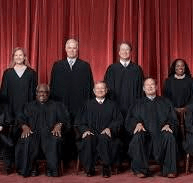
Why Does SCOTUS Push Homosexuality? (Part I)
President Eisenhower stopped gay rights in 1953, and condemned homosexuals in federal employ as “wickedness in government.” Why did the Supreme Court give gays new life in 1958 by ‘apparently’ suggesting that homosexual magazines were not ‘obscene’ and had “redeeming social value?” ‘Apparently’ as the reasons for the ruling were not specified [on the same day the court also didn’t specify why the publication of nudist magazines was ‘constitutional’].
The US Constitution in no way protects homosexuality, nor do the writings of the men who created it. In 1779, 21 years before his presidency, Jefferson addressed homosexuality in Virginia law reforms. Instead of homosexual acts remaining a capital crime, Jefferson recommended substituting mutilation (!): “Whosoever shall be guilty of Rape, Polygamy, or Sodomy with man or woman shall be punished, if a man, by castration, if a woman, by cutting thro’ the cartilage of her nose a hole of one half inch diameter at the least.”
Jefferson’s correspondence with James Madison and other Founding Fathers reveals that they agreed with Jefferson about everything above, except lessening the penalty for rape (even Jefferson felt it gave vengeful women too much power). There was no sentiment for lessening the penalties for homosexuality. None (see monticello.org/research-education/thomas-jefferson-encyclopedia/bill-64/).
Some laws against homosexuality were softened as liberals (as Jefferson) sought to reduce the number of capital crimes. Nevertheless, their writings and correspondence indicate they all abhorred it. President Eisenhower’s opinion that homosexuals were “wicked” would have found no dissenters among the Founders, and Ike’s characterization appears to have been only the second mention of the issue by a President. Indeed, as Charles Rice (1984) noted “homosexual liberalization is one of the clearest examples of the judicial formulation of public policy without any discernible warrant in the Constitution.”
In 1820 Jefferson wrote, in agreement with Robert Yates’ earlier warning that the courts were going to be tempted to dominate the government unless the Constitution was fixed, “the judiciary of the United States is the subtle corps of sappers and miners constantly working underground to undermine our Constitution from a co-ordinate of a general and special government to a general supreme one alone.” When the Supreme Court [SCOTUS] ruled that Black slaves were not citizens, Lincoln said that the decision was binding on the parties in that case, but if “the decision to stand as settling the law for all time, we should, to that extent, cease to be our own rulers, having practically resigned our government into the hands of that eminent tribunal.” SCOTUS’ support of homosexuality continued when, in 2015, by a 5 to 4 vote, it ruled, “all states must license a marriage between two people of the same sex.” No wonder most of the media currently consider the Supreme Court to have dictatorial power. Such is suggested by this frequently used May 19 headline about controlling Trump:” Supreme Court Allows Trump to Strip Legal Status From Venezuelan Migrants.” SCOTUS “allowed” Trump to act. But it might reverse itself if Trump does not allow ‘due process’ [e.g., a courtroom appearance by every migrant?], which – given the ~350,000 to be deported – would make it impossible to carry out in four years.
Worldviews in conflict
President Eisenhower was strongly influenced by the Christian worldview. The worldview the SCOTUS’ is currently following is suggested by Biden’s National Park Service postings. Huh? What does the Park Service have to do with homosexuality? A lot — its tax-funded website was helping to convince viewers to regard homosexuals as victims, stating:
“atheism, adultery, premarital sex, and homosexuality were believed to be spreading rapidly among Americans, especially within the State Department. … In 1950, …gay communities flourished in the shadows with little organized opposition. From the years of the Second World War to 1950, homosexuals were employed by the federal government, and Washington D.C. had become home to a burgeoning gay culture. However, federal indifference to homosexuality came to a screeching halt in 1950.” (emphasis added)
Note the “burgeoning” and “flourishing” of gay culture. Gays had colonized DC’s public toilets and parks for sexual trysts. It was believed gay employees were influencing all kinds of public policy (especially tilting the State Department toward aiding the USSR). Homosexuals were indeed burgeoning (e.g., increasing, thriving).
As Presidents Jefferson and Lincoln complained, SCOTUS can ‘rule’ the US on any topic. As things stand, five of its justices can ‘rule the US’ by issuing orders that block executive action. Further, if SCOTUS deems and action “unconstitutional,” that ‘action’ does not have to appear in the Constitution. And reversals of SCOTUS’ rulings become ‘constitutional’ by simply being replaced by new – and equally authoritative — ‘legal reasoning.’
Why did SCOTUS move so strongly against President Eisenhower’s 1953-1961 efforts to suppress homosexuality? The 1950s were unusually Christian — with Billy Graham crusades garnering positive publicity, a raft of popular Biblical movies, the national motto changed to ‘in God we trust’ [in 1956, the same year Ike called gays in government “wickedness”], and the population marrying and having lots of babies (the US went from 150 million in 1950 to 180 million in 1960). Churches were packed, with almost half of Americans attending on any given Sunday and 63% being members [both highest of all time]. But over half did not regularly attend, and some of these seethed with anger that the President was promoting Christianity.
Americans have been fiercely divided from the outset. Trump won the popular vote by an electoral landslide, but only 1.5% of the popular vote. Conservatives often despise liberals and vice versa. SCOTUS often serves as a kind of super-legislature, ‘finding’ things in the Constitution that were undiscovered before, but become ‘constitutional’ nonetheless (as a ‘right’ to privacy) depending on whether the Judges consider the Constitution a set of fluid principles or adhere to a more limited interpretation. When one side of the aisle gains momentum, SCOTUS often votes for the other (seems to tend toward being oppositional if society is going one way politically) to achieve some sort of political ‘balance’ and keep its powers from being questioned.
The same year that Eisenhower moved against homosexuality, homosexuals in LA started a magazine promoting it. SCOTUS got involved when a libertine young lawyer named Eric Julber (who claimed to not know a gay), came to DC to deliver the magazine to Judge W.O. Douglas’ law clerks. Julber was a bright but obtuse lawyer. Obtuse? A court of appeal judge “found a phrase in one of the articles that appeared there, a humorous poem” that talked about a guy who got into legal trouble “because of his ins and outs with various Scouts” and he pointed to that as an obscene reference to homosexual conduct. [years later Julber said] “I couldn’t see it, having no experience with the subject, really – my only association with gays has been in this case.” The ‘humor’ was about being caught buggering Boy Scouts! Gays find it humorous that they use public restrooms for sex and even more amusing to use “various Scouts” for anal “in and outs.”
[FRI’s analysis of every ‘child sexual abuse’ story in Google News 2012-21, documented that a third (872) of the 2,632 US perpetrators had engaged in homosexuality; these gay perpetrators accounted for half (2,965) of the 5,679 child victims. Across the English-speaking world, of Boy Scout leaders making Google News, 42 of 44 violated 181 boys — 97% of their 186 child victims. Gay’s ‘humorous’ love of boys, encouraged by SCOTUS’ decision to allow them to use the US mails, eventually bankrupted the Boy Scouts; gay priests accounting for 83% of the 203 perpetrators and 91% of the 1,136 victims, have bankrupted many a Catholic Diocese as well].
Julber’s efforts illustrate how heterosexuals – especially those of a libertine bent — can become homosexuals’ allies. After graduation, Eric was looking for a ‘civil rights case’ to put himself on the map. He knew almost nothing about homosexuality, yet he believed that those living in defiance of the law had the ‘right’ to use the mail to propagate their crime. He said in Esquire (1969) “when I was a student (and before it became fashionable) I grew a beard, became a vegetarian and a pacifist, meditated on mountain tops, read Marx and smoked pot. I am not an advocate of free love or promiscuity, I believe in the traditional virtues, that a man should have just one wife and one mistress.” He gave some of the homosexual magazines to law clerks because they “are very influential on the judges that they work for. Law clerks, they’re not secretaries [but] young lawyers who do research and they advise the court as to what they found in the research and what their opinions are..it’s very important to get law clerks on your side.”
Julber revels in his success with SCOTUS but seems guarded about what he helped unleash such as Pride Parades, trans, and homosexual nests. When asked for his opinion about gay liberation Julber claimed: “That’s far beyond my expertise or knowledge. I don’t know, because I’m not gay. Never have been. Really, my only association with them has been in this case, so I really can’t say.” Yet Faderman (2006) claims he consulted “on the magazine, reviewing each issue for material that could potentially get ONE labeled as obscene” over 4 years, so he could not be very ignorant. Since he died in 2022 and had had numerous wives, mistresses, divorces, and children, he well knew the damage he had helped inflict on society. Young people often fail to seriously investigate why society made certain sexual activities illegal, believing ‘everyone should be able to do what they want.’ And the same is true of older libertines, who at times make it to the Supreme Court (or Congress, or the Presidency).
As it turned out, one of the SCOTUS Judges was as libertine as Julber but far more powerful. He helped invent the notion that “All ideas having even the slightest redeeming social importance — unorthodox ideas, controversial ideas, even ideas hateful to the prevailing climate of opinion — have the full protection of the guaranties” of the 1st Amendment (Roth vs. US, June 24, 1957). While no Justice has absolute power, power corrupts. And knowing that if four others join their side, they can rule the most powerful country in the world, is tempting.
Continued next issue.
Ref: Faderman (2006), Lillian. Gay L.A: a History of Sexual Outlaws, Power Politics, and Lipstick Lesbians. New York: Basic Books, 2006.
© June 2025 Paul Cameron, Ph.D. www.familyresaerchInst.org POBox 62640 Colorado Springs, CO 80962
Straight backlash HERE!

 Break The Matrix
 Children's Health Defense
 Dan Bongino – The Dan Bongino Show
 Dr. Dave Janda
 Dr. David Martin
 For The Love of Freedom
 G. Edward Griffin – Need To Know News
 Greg Hunter USA Watchdog
 Jack Kettler – Underground Notes
 James Corbett – The Corbett Report
 John Stossel – Fox Business
 Luke Rudowski – We Are Change
 McAlavany Commentary
 Mercola
 Mike Adams – Natural News
 Mike Rivero – What Really Happened
 Paul Cameron – Family Research Institute
 Paul Craig Roberts – Institute for Political Economy
 Paul Joseph Watson
 Peter Schiff – Schiff Radio
 Ron Paul – Campaign for Liberty
 Stefan Molyneux – Freedom Radio
 The New American Magazine
 Thomas Sowell
 VisualPolitik EN
 aceloewgold
 pensiamentopeligroso
 Touch Stone Connect