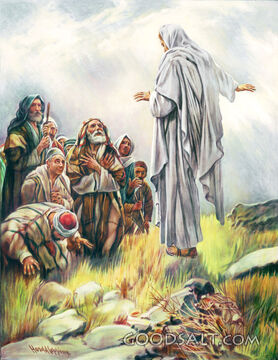
Matthew chapter 28 verses 19 Go [a]therefore and make disciples of all the nations, baptizing them in the name of the Father and of the Son and of the Holy Spirit, 20 teaching them to observe all things that I have commanded you; and lo, I am with you always, even to the end of the age.” [b]Amen.
The above quote refers to the “Great Commission” which Jesus gave to His believers and followers! Let’s examine its meaning. Beginning in verse 20, He says “make disciples…” “…teaching” ALL nations” – “All” presumably means all – not some, or most, or most all, but “all”! (nations would include government leaders) to “observe” ALL meaning to closely look at and follow (again, “All” presumably means all – not some, or most, or most all, but “all”!) Then, “ALL things that I have commanded you”. (again, “All” presumably means all – not some, or most, or most all, but “all”!) Now, the rub may come in what He “commanded” them.
Jesus regularly quotes from the Old Testament, and according to Presbyterian and Protestant Theology, and even the Roman Catholics acknowledge the Trinity, so that means that Jesus Christ is GOD in the flesh. Collossians 1:15 – 20 should be a sufficient confirmation of that. If so, then Jesus Christ is GOD in the flesh, and therefore the author of ALL of the Old Testament Commandments (again, “All” presumably means all – not some, or most, or most all, but “all”!)
If I am in error on that, now is the time to correct me. If I am correct, then is there any reason why His commandments should not be taught to ALL nations? (again, “All” presumably means all – not some, or most, or most all, but “all”!) If not, then should the Gospel of salvation part of Scripture be taught only from the pulpit and at the expense of the law (commandments), specific sins, understanding and exposition of those sins and the applications of the law regarding those sins? Should the pulpit ignore teaching any of the nuances of the Ten Commandments? For example, what if people are sinning through ignorance? Should the pulpit educate them as to some of the most egregious sins committed in ignorance? As an example, sins mentioned in Scripture and the Westminster Catechisms both include, but are not limited to; unjust weights and measures, fraud, favoring the poor at the expense of the rich, and many, many more things.
Is it the duty of the pastor to teach Scriptural applications about these subjects, or should it be left up to the individual to figure it out for themselves leaving the Pastor unencumbered by the weightier details of the law? To love GOD and your neighbor are more important than finely nuanced scholarly Theological points. Yes, tithing mint is good, but don’t overlook the more important things.
Pensiamento Peligroso

 Break The Matrix
 Children's Health Defense
 Dan Bongino – The Dan Bongino Show
 Dr. Dave Janda
 Dr. David Martin
 For The Love of Freedom
 G. Edward Griffin – Need To Know News
 Greg Hunter USA Watchdog
 Jack Kettler – Underground Notes
 James Corbett – The Corbett Report
 John Stossel – Fox Business
 Luke Rudowski – We Are Change
 McAlavany Commentary
 Mercola
 Mike Adams – Natural News
 Mike Rivero – What Really Happened
 Paul Cameron – Family Research Institute
 Paul Craig Roberts – Institute for Political Economy
 Paul Joseph Watson
 Peter Schiff – Schiff Radio
 Ron Paul – Campaign for Liberty
 Stefan Molyneux – Freedom Radio
 The New American Magazine
 Thomas Sowell
 VisualPolitik EN
 aceloewgold
 pensiamentopeligroso
 Touch Stone Connect