
Under any circumstances, actions taken by governments take months if not years to fully manifest themselves in the economy especially!
Real world economics is messy and doesn’t seem to be terribly affected by deficits.
Ontario Would Be Fifth-Poorest, Quebec Second-Poorest, U.S. State

By Dominic PinoNat Review
September 19, 2024 12:45 PM
“Compared to the same period last year, per capita GDP is now down 2.2 percent. Compared to 2022, it’s down 3.6 percent,” Tombe writes. “As RBC analysts correctly noted, this is a ‘recession-like’ performance.”
“A longer historical perspective reveals a striking reality: the gap between the Canadian and American economies has now reached its widest point in nearly a century,” he continues. “The U.S. is on track to produce nearly 50 percent more per person than Canada will.”
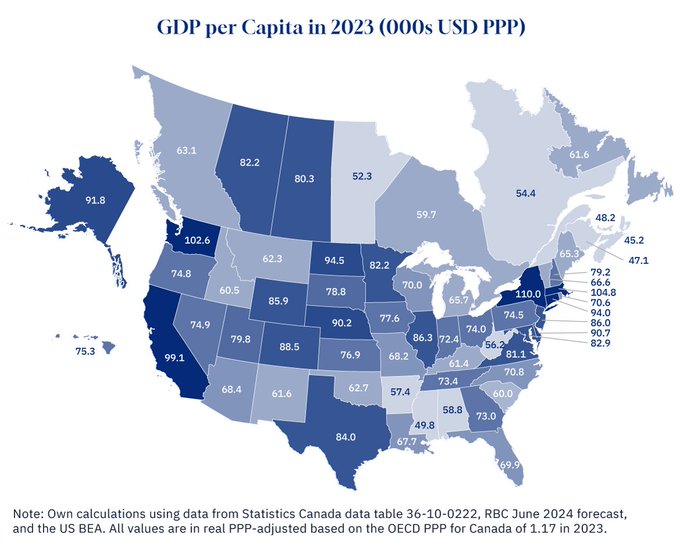
In a post on X promoting the story, Tombe included a map of U.S. states and Canadian provinces by GDP per capita. The data are measured in U.S. dollars, at purchasing-power parity.
It shows that Ontario, home of Canada’s business capital of Toronto, would be the fifth-poorest U.S. state if it joined the union today. Ontario’s GDP per capita is $59,700. Only four states — Alabama ($58,800), Arkansas ($57,400), West Virginia ($56,200), and Mississippi ($49,800) — have lower GDPs per capita.
Quebec, with a GDP per capita of $54,400, exceeding only Mississippi’s, would be the second-poorest U.S. state.
If Nova Scotia ($45,200), New Brunswick ($47,100), or Prince Edward Island ($48,200) joined the U.S., they would each be the poorest U.S. state.
There are high-performing Canadian provinces. Alberta, with its oil-and-gas resources, has a GDP per capita of $82,200, same as Minnesota and only slightly behind Texas. Saskatchewan, too, is doing well at $80,300.
But the U.S. in general is pulling away from Canada, just as it is pulling away from Europe, in economic growth.
By Dominic Pino
April 18, 2023 7:13 AM
Does the U.S. economy have problems? Absolutely. It always has, and it always will. There’s always room for improvement, and policy-makers have plenty of work to do.
It still remains true that despite those problems, the U.S. economy significantly outperforms its peers. That’s the subject of the Economist’s most recent cover story. The British paper doesn’t have a dog in the U.S. domestic partisan fight, and it steps back to admire what the U.S. economy has done.
Dominic Pino (again)
Here are some of the facts the Economist points out:
- In 1990, the U.S. share of the G7’s GDP (the U.S., U.K., Canada, France, Germany, Italy, and Japan) was 40 percent. Today, it’s up to 58 percent.
- In 1990, the U.S. share of world GDP was about 25 percent. Today, despite China’s rise and Japan’s fall, it remains about the same.
- By purchasing-power parity, only petrostates and small countries with financial hubs have higher average incomes than the U.S.
- And the U.S. is still pulling away: Average income growth in the U.S. is higher than in Europe or Japan.
- The poorest U.S. state, Mississippi, has a higher average income than France.
- The U.S. has almost 33 percent more workers today than it did in 1990. Western Europe and Japan only have 10 percent more.
- More American workers have graduate and postgraduate degrees than workers in Western Europe or Japan.
- American workers are more productive as well.
- Over 20 percent of patents registered abroad belong to American companies, more than China and Germany combined.
- The top five corporations by R&D spending are all American.
- Putting $100 in the S&P 500 in 1990 would leave you with over $2,000 today. That’s four times more than if you had put it in any other wealthy country’s stock market.
- Incomes in the lowest quintile in the U.S. have risen by 74 percent, adjusted for inflation, since 1990.
The piece notes challenges with labor-force participation, drug overdoses, and middle-class income rising slower than upper- and lower-class incomes. Another problem it doesn’t mention is the federal government’s looming fiscal disaster and politicians’ unwillingness to spend responsibly.
But for most people, there’s no economy better than America’s. Zooming out from day-to-day politics, it’s clear that the U.S. free-market system is doing something right. America’s more managed peers [and smarter, they believe] in Europe and Japan just aren’t doing as well. The Economist points to how easy it is to start a business in the U.S. — and how easy it is to work through bankruptcy and try again. It also points to something the Founders gave us: a massive common market between the states.
Though there are problems to be solved, and things could be better, the doom narratives from the left and the right should be put in perspective. “The more that Americans think their economy is a problem in need of fixing, the more likely their politicians are to mess up the next 30 years,” the Economist says. Let’s not talk ourselves into stagnation.

Trevor Tombe
@trevortombe
The gap between the Canadian and American economies has now reached its widest point in nearly a century. My latest for
here: https://thehub.ca/2024/09/05/trevor-tombe-the-great-divergence-canadas-economic-gap-with-the-u-s-reaches-a-new-record/…#cdnecon#cdnpoli
·
Individual greed and desire to excel in the US economy works, dictators or dictatorial regimes don’t work as well. No one is smart enough to know enough to outperform the US beehive of greedy, self-interested workers/owners. Most dictators are smart, but far from smart enough to know enough to manage (or even keep from harming) any modern economy.
Being poor in the US is similar to being middle-class or even well-off in much of the world.
Perhaps the continual political contest between the conservatives and liberals help keep the US so productive while spreading the wealth?
Sent From F.R.I.
Pensiamento Peligroso

 Break The Matrix
 Children's Health Defense
 Dan Bongino – The Dan Bongino Show
 Dr. Dave Janda
 Dr. David Martin
 For The Love of Freedom
 G. Edward Griffin – Need To Know News
 Greg Hunter USA Watchdog
 Jack Kettler – Underground Notes
 James Corbett – The Corbett Report
 John Stossel – Fox Business
 Luke Rudowski – We Are Change
 McAlavany Commentary
 Mercola
 Mike Adams – Natural News
 Mike Rivero – What Really Happened
 Paul Cameron – Family Research Institute
 Paul Craig Roberts – Institute for Political Economy
 Paul Joseph Watson
 Peter Schiff – Schiff Radio
 Ron Paul – Campaign for Liberty
 Stefan Molyneux – Freedom Radio
 The New American Magazine
 Thomas Sowell
 VisualPolitik EN
 aceloewgold
 pensiamentopeligroso
 Touch Stone Connect